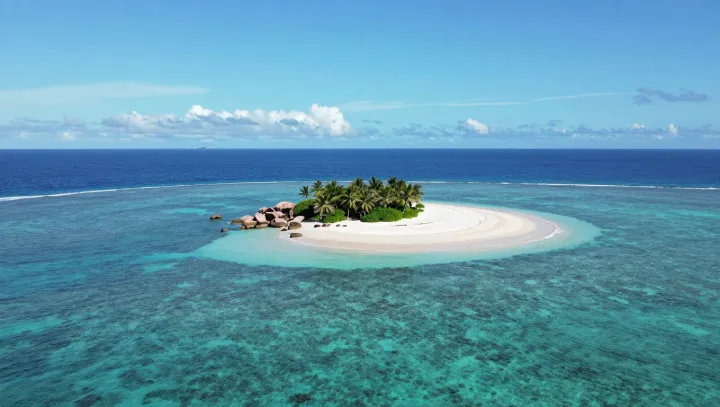
Color cheats first. At the shoreline, that almost radioactive turquoise is not about exotic plankton or some secret dye; it is about how pure water edits the spectrum. Sunlight arrives as full-spectrum white, but the liquid at your ankles acts like a quiet optical filter, already starting to discriminate between wavelengths.
The surprise is that red dies almost immediately. In just a few meters, absorption coefficients for longer wavelengths ensure that red photons are swallowed by water molecules, their energy converted to a faint bit of heat. Short path, bright palette. Because the depth is shallow, enough green and blue light still scatter back to your eyes, and with the sandy bottom reflecting, the mix skews toward neon turquoise, boosted by Rayleigh and Mie scattering off tiny particles.
Farther out, the ocean grows ruthless. As the water column thickens, exponential attenuation described by the Beer–Lambert law strips away more green, leaving predominantly blue wavelengths to survive the journey down and back. The bottom drops out of view, so there is no pale sand to lighten the scene; less backscatter, more absorption, and the hue drifts from electric to ink. What you see as a color gradient is really a depth map written in selective spectral loss.