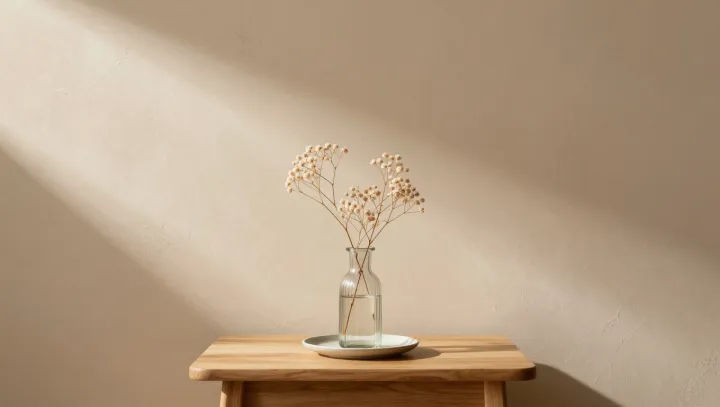
Luxury hides in restraint, not in volume. A plain glass vase holding only a few sprigs of baby’s breath instantly establishes negative space as the main material in the room, turning emptiness itself into a kind of visual currency that high-end interiors trade on.
Crowded bouquets shout; sparse stems edit. High-end retail and hospitality design rely on visual hierarchy and figure–ground contrast, using empty zones to frame a single object so the eye assigns it higher perceived value, a principle supported by consumer psychology experiments on product spacing and price bias. When most of the cylinder is just air, the eye reads the remaining stems as deliberate, almost curated with museum-level discipline.
The real signal is control, not cost. A clear vase, transparent and undecorated, behaves almost like negative feedback in an acoustic system, dampening visual noise so that a few pale blooms can interact with light, reflections and shadow. The glass throws subtle highlights on the table; the thin white clusters hover, detached from clutter. Overstuffed arrangements, by contrast, compress every surface into pattern, collapsing depth and making even expensive flowers feel like generic décor rather than a considered choice.