
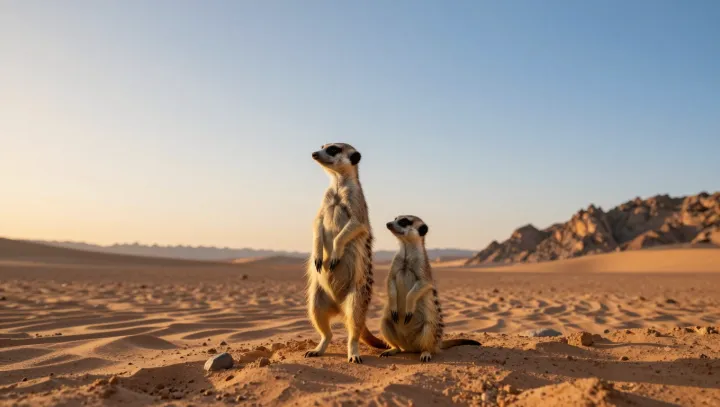
Blinding glare is exactly what meerkats seem to invite when they stand bolt upright facing the rising sun. Yet their eyes stay intact. Around each eye sits a ring of dark fur that works like a built‑in visor, reducing stray light through simple absorption of high‑energy rays before they scatter across the cornea and lens.
More interesting than the fur is the way the whole visual system leans into this design. Behind the pupil, densely packed photoreceptors in the central retina and a specialized area centralis handle high contrast edges, while rapid pupillary constriction limits irradiance on the fovea when the horizon flares bright. Short snouts keep bone from casting deep shadows, so the eye patch becomes the main optical baffle, trimming lateral glare while preserving a narrow, predator‑watching slit of visibility.
Most decisive, though, is the group choreography on those sandy mounds. Only a few animals take the full glare load as sentinels at any moment, and they rotate that post, distributing cumulative retinal exposure across many individuals. Others stand at slight angles, using oblique gaze to keep the sun just outside the direct visual axis, which moves the highest photon flux away from the most light‑sensitive retinal zones and lowers long‑term damage risk for the colony as a whole.