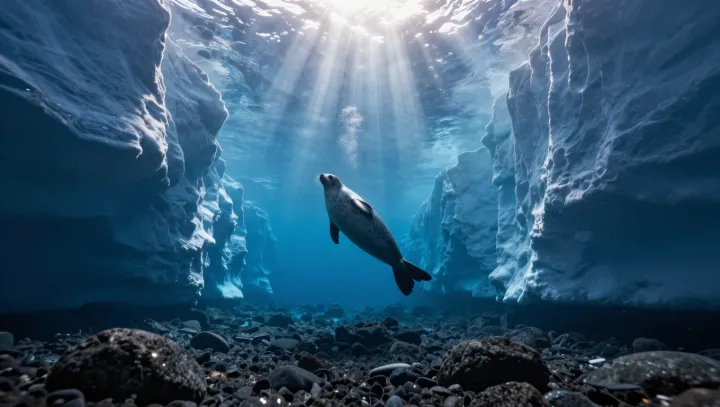
Sea ice cheats the human eye first, not the seal. What looks like a flat, milky lid from above is, in optical terms, a scattering shield that kills contrast and scrambles light before it even reaches a snorkeler’s retina.
Under that lid, the rules invert. Light that survives the ice is mostly blue‑green, already filtered and traveling in a narrow cone. To a human at the surface, multiple interfaces – air, wet snow, ice, brine pockets, then water – create layered refraction and backscatter, so the water column reads as murk. A seal below the ice faces only the water–cornea interface, and its cornea and lens are shaped so that refraction in water still forms a tight focal point on the retina rather than a blur circle.
The real advantage is not mystical acuity; it is ruthless specialization. Seal retinas are packed with rod photoreceptors and a reflective tapetum lucidum, boosting sensitivity in low photon flux where humans operate near threshold. Their pupils can constrict into odd slit patterns that control spherical aberration and let peripheral rays, which carry contrast at long range, reach the foveal region with minimal optical noise. Add a high density of short‑wavelength sensitive pigments tuned to that blue‑green band, and the scene that looks like gray soup from above resolves, for the hunter below, into a corridor of usable detail stretching tens of meters.