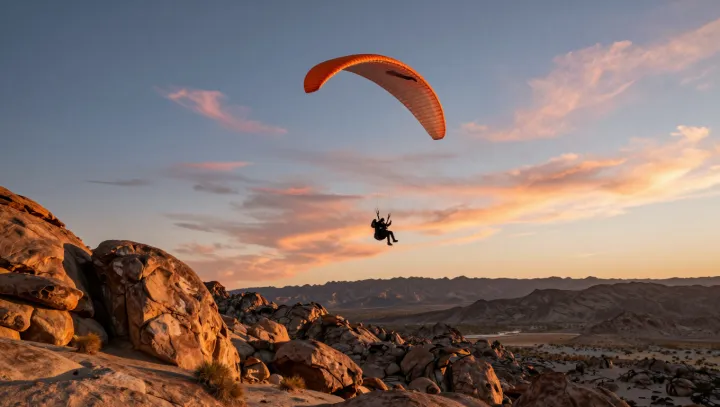
Those wings do not float by magic; they surf a moving fluid. Air flows toward the desert ridge, hits the slope, and is forced upward in a clean, predictable stream. That rising flow, called orographic or slope lift, behaves like a slow escalator, and a paraglider is built to ride it with almost obscene efficiency.
The key is that the wing is a true glider, not a parachute. Its high lift‑to‑drag ratio means forward speed through air is constantly traded for lift, described by basic lift equations and angle‑of‑attack control. When the surrounding air itself is moving upward along the ridge, the pilot’s sink rate relative to the ground is canceled or even reversed, so altitude barely changes while meters of distance slide by.
The surprise is that those invisible rivers do not only hug the slope. Over heated desert rock, rising columns called thermals punch upward like slow‑motion geysers. A pilot circling in a thermal uses coordinated turns and precise brake input to stay inside the core, where vertical velocity of the air exceeds the wing’s natural sink rate. Combine sustained slope lift with intermittent thermals, add a smooth evening breeze, and the need for engines or flapping simply disappears.