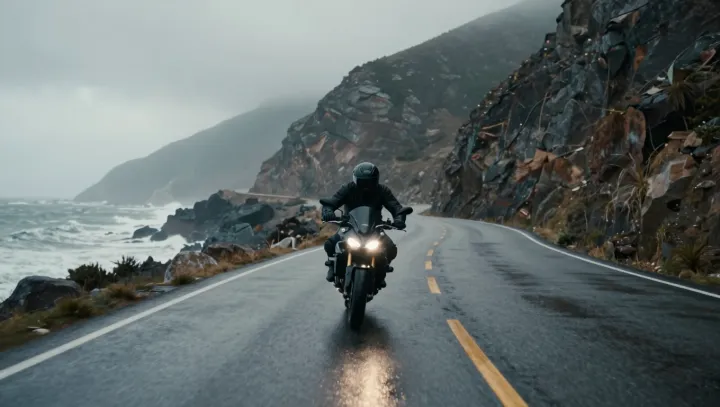
A tiny twitch against the bend decides whether a superbike glides or slides on wet asphalt. That brief, wrong-way input is not a mistake; it is the entry ticket to high lean stability. By steering the bars slightly opposite the curve, riders trigger countersteering, which uses angular momentum and gyroscopic precession of the wheels to snap the chassis into lean far faster than body movement alone ever could.
The unsettling truth is that grip on a soaked mountain road grows more predictable when the rider commits to this physics, not when they tiptoe around it. That opposite bar pressure creates a controlled yaw moment, then the front tire settles into a small slip angle where lateral force, described by tire cornering stiffness, rises in a smooth, linear band. Once there, the bike behaves like a loaded spring: stable, self-correcting, ready to absorb mid-corner bumps that would unseat a hesitant rider.
Most spectators assume survival comes from slowing down; elite racers treat speed as a tool to keep the geometry alive. With sufficient velocity, trail, caster angle and wheel spin build a strong self-aligning torque that keeps the contact patches tracking even across glossy paint or damp leaves. The bar input looks casual. It is not. It is a precise conversation with inertia, written in millimeters of wrong-way turn.