
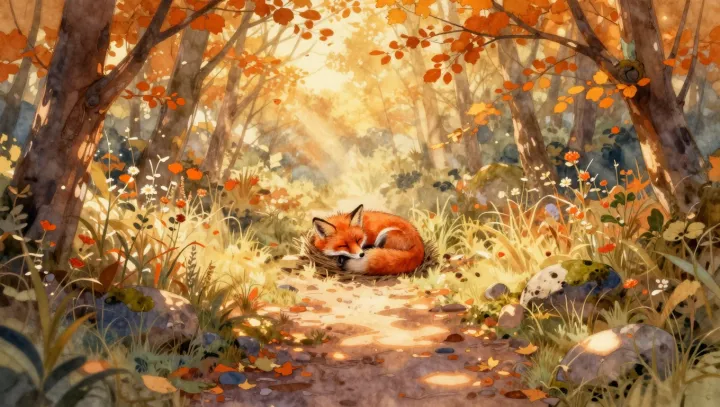
Safety for a sleeping fox is less about shelter than control. In open forest, leaf litter becomes both mattress and sensor field, a thin layer that slows conductive heat loss while transmitting faint vibrations from hoof or paw. Dry leaves trap small pockets of air, giving modest insulation, yet they also act like a crude seismograph under every rib and joint.
Comfort, though, is clearly sacrificed. The animal curls tight, nose tucked to tail, shrinking its exposed surface area in a textbook case of thermoregulation and boundary layer management. One eye often stays half open, a classic unihemispheric sleep pattern in which one cerebral hemisphere remains more active, keeping auditory and olfactory circuits on a hair trigger.
Darkness is not its ally; dim light is. A fox often chooses a slight rise or forest edge where ambient skyglow gives a clean horizon, letting any moving silhouette break the line. Head angled downwind, it uses prevailing airflow as an information stream, so that scent arrives before threat. What looks like vulnerability, spread on bare leaves, is in practice a low‑cost surveillance system running all night.