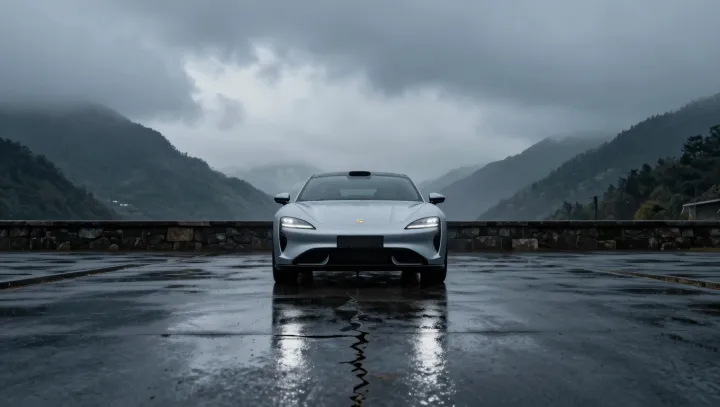
Rain does the styling work that daylight refuses to do. On a wet road under dark clouds, a silver sports car enters a lighting regime that flatters its geometry and hides its visual noise. The asphalt becomes a giant, low gloss mirror: it reflects streaks of sky luminance and headlamp glows, but with reduced diffuse scatter, so the car’s specular highlights stand out as clean, bright edges along fenders and roofline. Against the dim, desaturated background, the human visual system shifts into contrast hunting mode, with retinal photoreceptors and cortical edge detectors amplifying the hard transitions between chrome, bodywork, and shadow.
Bright sunshine, by contrast, is unforgiving. It floods the scene with high overall luminance, compresses dynamic range at the retina, and triggers glare that smears subtle curvature cues. Silver paint, already high in reflectance, can clip toward uniform brightness, washing away the micro contrast that defines creases and vents. Under storm clouds, global illumination drops, but localized specular reflection spikes along wet surfaces and polished metal. That pairing, supported by mechanisms like lateral inhibition and luminance adaptation in the visual cortex, exaggerates contour and depth. The car looks sharper not because it changes, but because the atmospheric dimmer switch reprograms how the eye carves it out from the world.