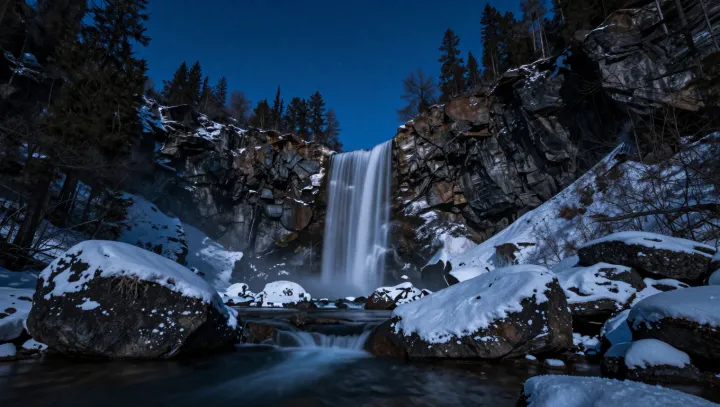
That silky waterfall is not magic at all; it is selective cheating with time. A long exposure forces every droplet that rushes through the frame to be averaged into a continuous streak, while the stars, crawling across the sky at a far slower angular rate, barely shift on the sensor during the same interval.
Key here is motion relative to each pixel, not raw violence in the scene. Water in free fall can cross dozens or hundreds of pixel widths during one open shutter, so the sensor integrates its changing position into a smooth luminance band, a direct consequence of temporal integration and the finite sampling frequency of the photosites. Stars, by contrast, sit so far away that their apparent motion, driven by Earth’s rotation, is extremely small over a moderate exposure, often less than a fraction of a pixel, so their point-spread function stays tight and crisp.
The surprise is that cold air and ice hardly matter; geometry does. A tripod locks the camera’s reference frame, image stabilization is disabled to prevent micro-drift, and the shutter speed is tuned to sit in a narrow window where water covers many pixels, yet stellar drift remains sub-pixel. Change that balance with a longer exposure or a wider focal length, and the stars smear into trails while the waterfall turns from silk back into individual shards of spray.