
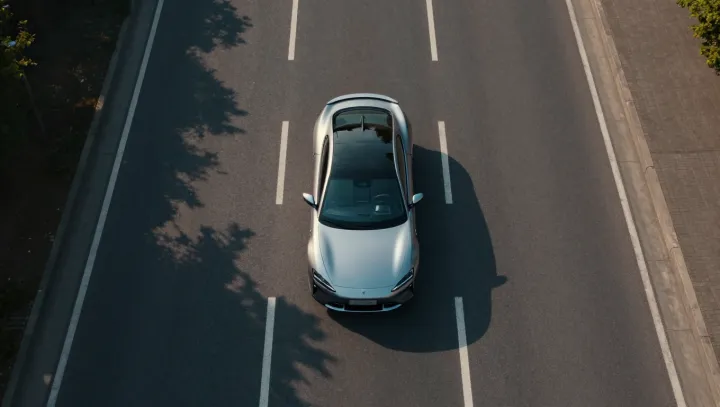
Air, not horsepower, is the real reason a supercar feels calmer at 200 km/h than a family hatchback does at 80. At low speed, both cars mostly behave like simple masses on springs, but as velocity climbs, the air load grows with the square of speed and starts to dominate how the chassis talks to the road.
Stability, in truth, is engineered into the airflow. A modern supercar trades some drag coefficient for intentional negative lift, or downforce, using front splitters, diffusers, and carefully shaped underbodies. That contouring turns the floor into a crude inverted wing, lowering static pressure beneath the car and generating hundreds of kilograms of extra normal force at high speed, so the tires press harder into the asphalt instead of skimming over it.
Family cars quietly accept the opposite bargain. Their priority is low drag and fuel economy, so bodywork, ride height, and soft suspension often allow slight positive lift and more yaw sensitivity as speed rises. The center of pressure can wander away from the center of gravity, so crosswinds or lane changes feed small steering inputs into larger body motions, which the driver reads as nervousness long before any limit is reached.
The counterintuitive result is simple. At 200 km/h, a supercar can carry more mechanical grip and directional stability than a softly sprung commuter at half that speed, because aerodynamics has been weaponized: not just cutting through the air, but using Bernoulli pressure fields and ground effect to pin the car harder into the road the faster it goes.