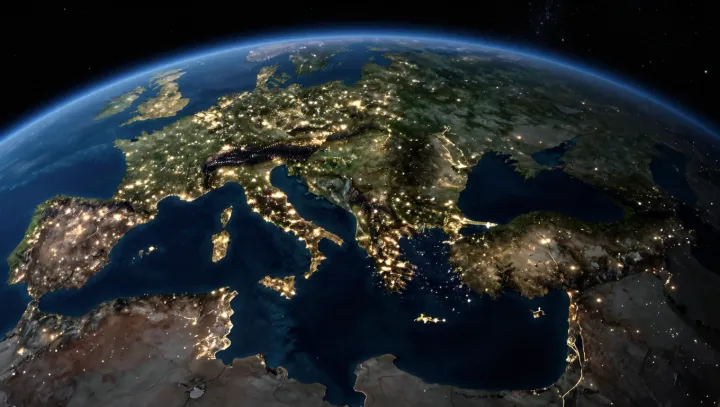
City lights glitter against the night, yet physics says this glow is a brief statistical accident, not a prelude to fireworks. Most matter, according to statistical mechanics, prefers uniformity, so tonight’s bright clusters of energy and life sit wildly off the most probable state of the cosmos.
Physicists argue that a quiet end wins by sheer probability, not drama. Thermodynamics pushes entropy up; high-energy gradients that power stars, cities and chemistry almost always flatten out into near-equilibrium, a so-called heat death, while runaway detonations require fine-tuned, unstable conditions that equations like the Friedmann solutions treat as edge cases, not the rule.
The darker forecast also leans on cosmic expansion. As space stretches, galaxies drift apart, radiation redshifts, and quantum fields settle into low-energy configurations; in many models, vacuum energy stays constant or fades, so no global trigger emerges for a final blast like a speculative Big Rip, which demands exotic equations of state that current observations mostly sidestep.
What looks intuitive from one lit hemisphere, that energy loves to flare and explode, turns inverted under the cold arithmetic of phase space, where overwhelmingly many microstates correspond to darkness, thin radiation and dead chemistry, and only a vanishing fraction look anything like a blue planet throwing sparks at the void.