Harsh sunlight is not the sedan’s enemy; it is its most ruthless stylist. On an open asphalt lot, solar irradiance pours onto the gray roof and hood, where high absorptance in the visible and near‑infrared spectrum converts that energy into heat through basic thermal conduction and convection. Air inside the cabin warms as the dashboard and seats re‑radiate in the long‑wave infrared range, and because glass blocks much of that wavelength, the familiar greenhouse effect traps the heat until the car feels like a slow oven.
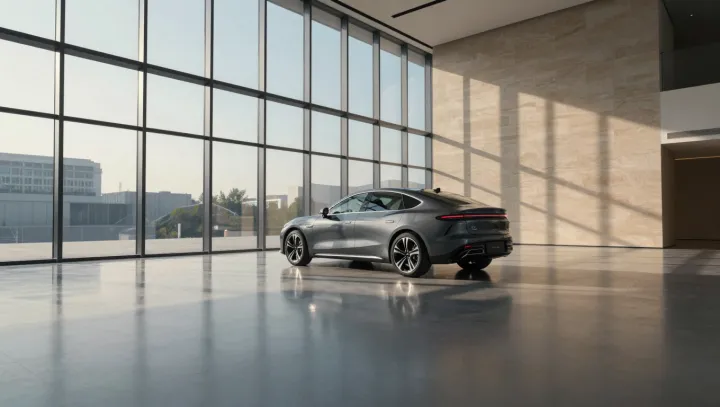
Inside a glass atrium, though, the same physics starts to flatter the car instead of punishing its occupants. Large panes act as selective filters and reflectors: low‑emissivity coatings and laminated glazing can cut a significant share of infrared while still transmitting a controlled band of visible light. That narrowed spectrum, arriving from a higher angle and bouncing off pale flooring and glass rails, boosts specular reflection on the sedan’s clearcoat, sharpens panel gaps, and deepens shadow lines along the beltline. What felt like glare outdoors becomes contrast indoors, and under that curated radiance a perfectly ordinary gray shell borrows the presence of a luxury showpiece.
So the heat and the glamour share a source, but diverge at the interface between radiation physics and human vision. Energy that once simply raised cabin temperature is, in the atrium, redirected, filtered and staged, and the sedan’s surfaces answer with crisper edges and cleaner reflections the eye reads as premium quality.