
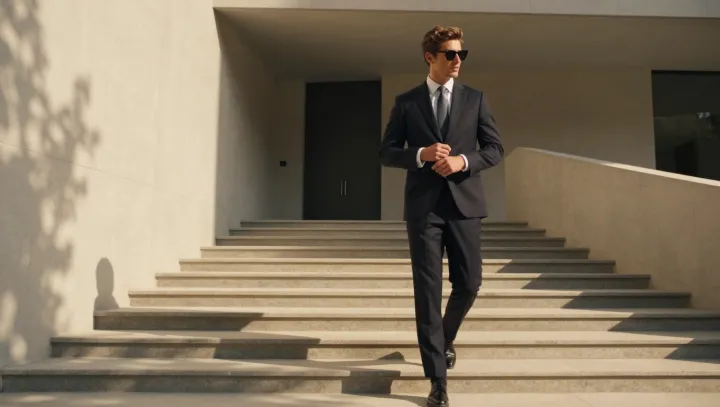
A staircase does the talking before the man ever moves. White steps, hard lines, a dark suit cutting through that light field; this geometry hits the brain faster than any biography, because the visual cortex and the amygdala fire long before language has time to assemble a story.
The blunt truth is that status is first assigned, then revised. In those opening heartbeats, observers lean on thin‑slice judgment and heuristic shortcuts that bind height, symmetry, and contrast to authority, so a tailored dark suit on a clean backdrop mimics the cues long associated with boardrooms, courtrooms, and formal power rituals.
Expertise, by contrast, is stubbornly slow. It lives in schema, track record, and signal detection over repeated interactions, which means it must be witnessed, tested, and stored in memory, while the suit‑on‑staircase tableau hacks pre‑attentive processing by turning the man into a high‑contrast focal point that crowds out subtler evidence.
Perception here is not fair, only efficient. The minimalist setting strips away noise, the vertical lines suggest ascent, and the dark fabric reads as intention and control, so the viewer assigns rank in three seconds, then spends the next decade, if the man is lucky, deciding whether that snap judgment deserves to survive.