
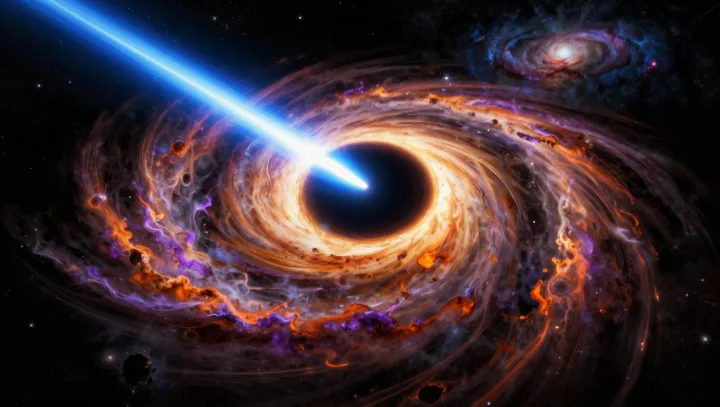
Around a black hole, brightness is not a paradox but a side effect. Light vanishes only once it crosses the event horizon, yet space just outside becomes a brutal energy factory where matter is forced to pay a final, blazing tax.
The key drama plays out in the accretion disk. Gas spirals inward. Friction heats it to millions of degrees. Radiation erupts across the spectrum. General relativity demands that spacetime itself drags around the spinning hole, and this frame dragging stirs the disk like a cosmic whisk, driving shear, turbulence, and shock waves that convert gravitational potential energy into light long before particles fall inside.
The jets look even more counterintuitive. They do not come from the center. They launch from the surrounding magnetic chaos. Twisted magnetic field lines thread the disk and the rotating black hole. In the Blandford–Znajek process, those fields tap the hole’s rotational energy and channel plasma along its spin axis. The result is a pair of narrow, relativistic jets that shoot matter away at nearly light speed while the horizon itself stays silent and dark.
So the black hole is not a lighthouse; it is the silent core of a storm, with gravity powering both the blinding disk and the knife-thin jets that seem to defy its pull.