
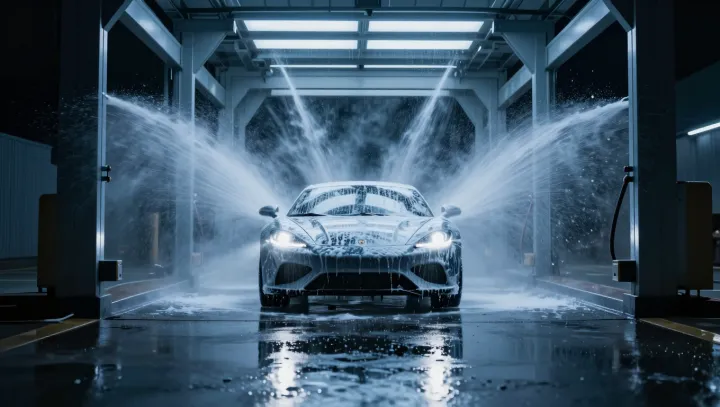
Water looks wild here. Behind that curtain of mist sits a machine that behaves more like a lab instrument than a garden hose, staging each blast according to geometry, pressure thresholds and droplet physics measured in fractions of a millimeter.
The harsh truth is that a car wash survives by walking a tight margin between force and damage. Engineers design nozzle banks so jets strike at a shallow incidence angle, turning water into a shear blade that exploits boundary layer flow and hydrodynamic lubrication, sliding micrometer‑thin films of road film off the clearcoat instead of punching straight into it. Computational fluid dynamics maps how those sheets of water spread and decelerate, so peak impact pressure lands on grit, not on pigment or primer.
Even the spray that looks like fog is not guesswork. Droplet size distributions are tuned through orifice diameter and pump pulsation to hit a sweet spot where inertia beats adhesive forces on particles, yet individual droplets remain too small to act as solid projectiles that could etch the polymer matrix. Pre‑soak surfactants drop surface tension so capillary forces let water creep under dirt, while rotating arches stagger jet timing to avoid resonant vibration in panels. What reaches the paint is not a storm. It is controlled erosion with the volume turned just low enough to leave the finish intact.