
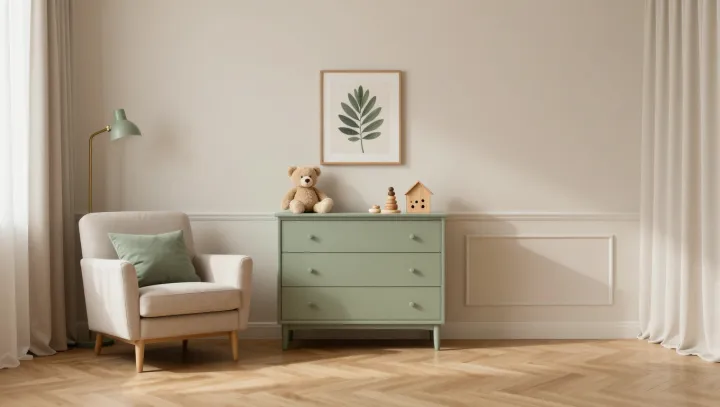
That beige wall is not betraying you. Light is. By late afternoon, the sun’s angle, filtered through dust and humidity, shifts the spectral power distribution of daylight, pushing more long wavelengths into your room and muting shorter ones. Beige, which sits near the boundary between warm and cool reflectance profiles, becomes a kind of visual chameleon under that changing illumination, even though a spectrophotometer would report identical paint reflectance.
The real surprise is that your brain cooperates in the trick. Human color constancy, driven by photoreceptor adaptation and opponent-process coding in the visual cortex, tries to subtract the tint of the ambient light to keep surfaces “stable.” It works, but only partially. As the dresser’s sage-green pigment reflects a different ratio of red and green wavelengths than the wall, the visual system recalibrates local contrast at every edge, so the same pair of surfaces can slide toward yellow, gray, or even faintly blue, depending on what else sits in the scene.
Designers like to blame bad bulbs. They are not wrong. LED spectra, with narrow emission peaks, exaggerate a phenomenon called metamerism, where two surfaces that matched under one light diverge under another. The afternoon sun, bouncing off floors, trees, or neighboring buildings, becomes its own wild lamp, rewriting the spectral script and forcing your brain to choose, again, what color that wall is supposed to be.