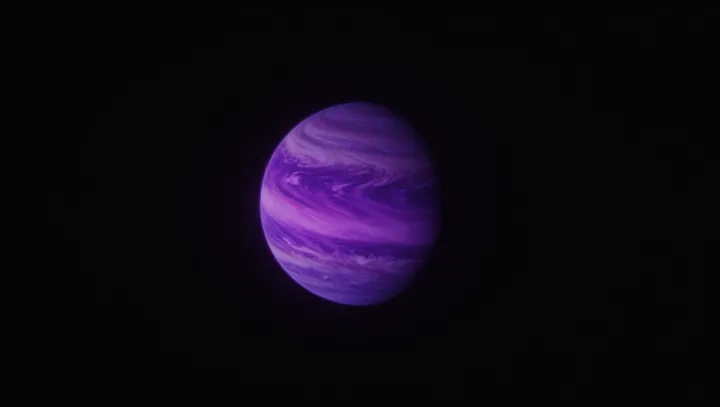
A black, starless world should be dead. That assumption ignores the quiet machinery inside a planet kicked free of its parent star, where radioactive decay and residual formation heat keep the interior warm while the surface drifts through interstellar cold.
More promising for liquid water than many sunlit rocks are these free floaters wrapped in insulation. A dense hydrogen atmosphere can trap geothermal energy through pressure broadening and infrared opacity, building a greenhouse strong enough to keep surface or near‑surface oceans from freezing solid, even when starlight is effectively zero.
Stronger still is the case for buried seas. An outer crust of high‑albedo ice behaves like a thermal blanket, while internal heating from radiogenic isotopes and possible tidal flexing from captured moons maintains a warm layer below the freezing point at the surface. That is the same thermodynamic balance that likely sustains subsurface oceans on Europa and Enceladus, only scaled to a whole wandering world.
Most plausible for life are slow, dim ecosystems. Chemosynthetic microbes could tap redox gradients at hydrothermal vents, driven by mantle convection and serpentinization rather than photosynthesis. No day or night cycle. Just persistent heat flow, liquid water, and dissolved minerals, a combination astrobiologists quietly rank alongside classic habitable zones around stars.