
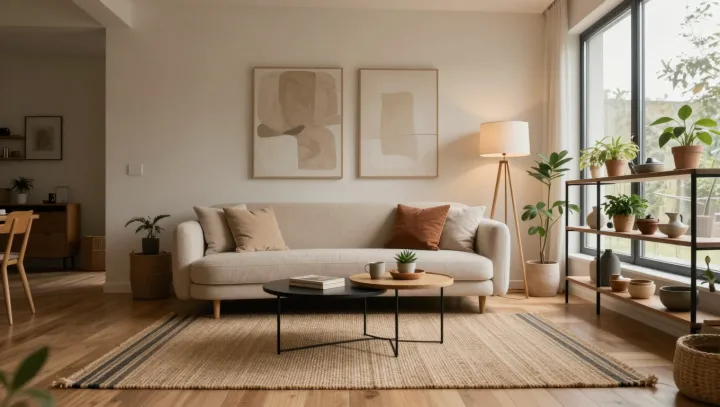
Beige walls are not soft. They are strict traffic controllers for the eye, reducing how often it must jump, refocus, and decode. In low-contrast rooms, studies using eye-tracking and functional MRI show shorter saccades, fewer fixations, and lower activation in regions handling visual search and figure–ground segregation. The scene offers fewer competing edges. The brain spends less glucose on sorting what matters from what merely exists.
Dark accents flip that equation. A single black frame on a cream wall becomes a high-salience cue; a grid of shelves packed with objects becomes dozens. Each contour and color boundary triggers orienting responses, tiny shifts in accommodation, and more work for visual cortex circuits tuned to luminance contrast. Cognitive load theory describes this as extraneous load: processing that does not advance any goal, yet still taxes working memory and attentional control.
The beige-and-cream palette, when paired with restrained shelving, quietly compresses that extraneous load. It lowers the density of visual stimuli per degree of visual angle and simplifies the scene’s spatial frequency profile, so the eye can glide instead of constantly recalibrating. Add dark, busy surfaces and the room behaves like a browser with too many tabs: each item pings neural circuitry, demanding a millisecond check-in, until fatigue feels mysterious but entirely earned.