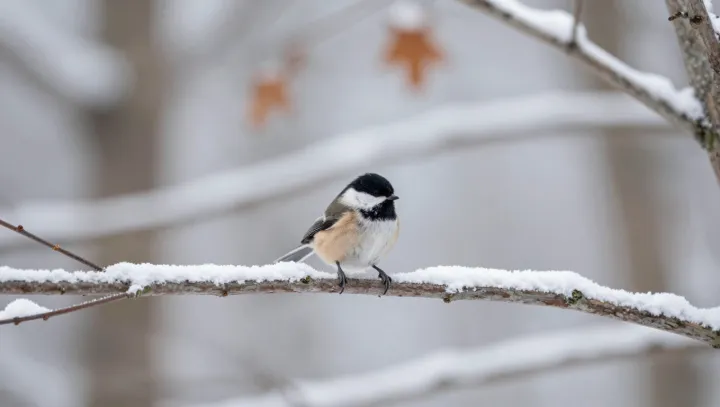
Cold, not size, is the real predator here. On an exposed branch, a chickadee faces heat loss so intense its body should shut down, yet its physiology turns that bare twig into a viable shelter by treating its own body as both furnace and insulation system.
Feathers do the first heavy lifting. Dense contour and down feathers trap still air, building a boundary layer that acts as a low-conductivity barrier; by fluffing, the bird expands this microclimate, cutting convective heat loss so much that core temperature can stay within a narrow range while ambient air sinks far below freezing. Short. This biological “down jacket” reduces the gradient that would otherwise rip heat from skin into open air.
The bolder trick lies in the head. Instead of defending a uniform body temperature, chickadees lean on selective brain cooling and controlled hypothermia, letting core temperature drop several degrees while keeping key neural circuits functional, a strategy that lowers metabolic rate and slows glycogen and fat depletion. Shorter still. Blood flow is shunted, peripheral tissues cool, and the brain is kept just warm enough to run essential sensorimotor control.
Energy, though, is the final currency. Rather than dramatic, full-body shivers, chickadees rely on micro‑shivering, brief, localized contractions in pectoral and leg muscles that drive shivering thermogenesis while barely raising overall oxygen consumption. Tiny pulses. These rapid contractions generate heat right next to major blood vessels, recapturing warmth before it escapes and stretching limited fat reserves through the entire night.