
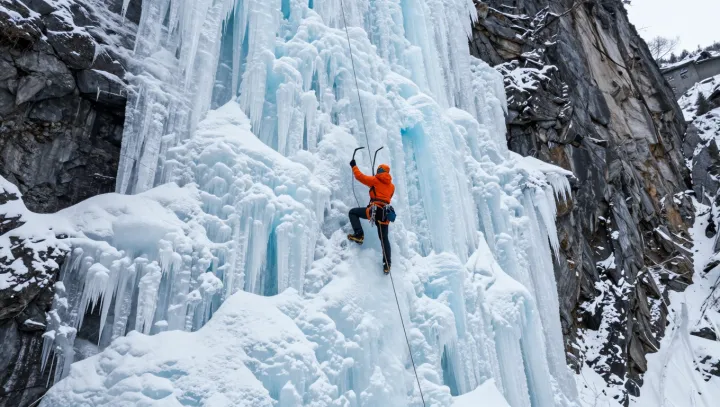
A long fall on ice is often kinder to the body than a tiny stumble. The physics is blunt about it. What matters first is not distance but fall factor, the ratio between how far the climber drops and how much rope is out. With more rope in the system, the same loss of gravitational potential energy is dissipated over a longer stretch of polyamide fibers, which enter elastic deformation and then hysteresis, instead of being dumped in a single brutal jolt.
Short slips close to the belay anchor can be harsh. Very harsh. Here the fall factor can approach its upper limit because there is little rope to stretch and little time for force to build gradually. In contrast, a multi‑meter fall mid‑pitch loads many meters of dynamic rope, so elongation, rope drag over carabiners, and controlled belay slippage create a long deceleration curve and a lower peak impact force on the climber’s harness.
The counterintuitive result is simple. A properly managed system with dynamic rope, well‑placed protection, and an attentive belayer turns a dramatic drop into a slow‑motion energy budget, where impulse and deceleration distance are engineered to protect human tissue while the frozen waterfall stays, mostly, intact.