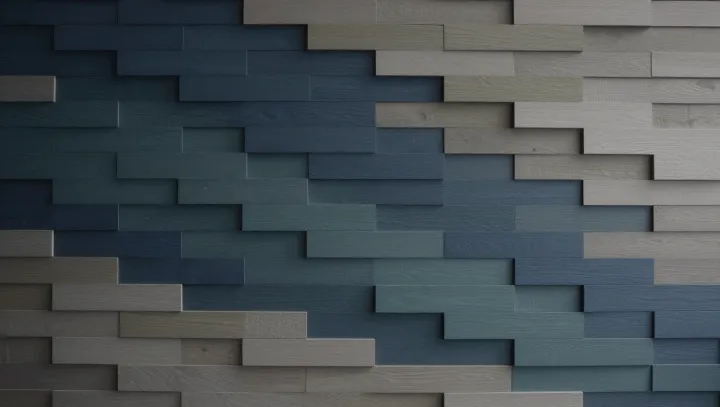
A flat wall behaves like a loud opinion; a staggered wooden one behaves more like a careful edit. Muted blues and grays keep the visual register low, yet the offset planks introduce a subtle spatial rhythm that a smooth surface simply cannot produce, because each change in depth alters how photons and sound waves strike and return from the wall.
Calmer is the first surprise. Low-saturation color reduces chromatic contrast, letting the eye rest, while the stepped geometry breaks what lighting designers call specular glare, turning harsh reflections into softer diffuse reflection that reads as a gentle gradient across the planks. Short sentences of shadow appear between boards. Longer bands slide across the wall as the light source shifts, so the room feels slower, less aggressive, even though the surface is more complex.
Yet more dynamic it becomes. Those small depth shifts act as a crude acoustic diffuser, scattering mid- and high-frequency energy instead of bouncing it straight back, trimming flutter echo and shrinking the room’s reverberation time. Conversation gains clarity. Footfall dulls slightly. The brain registers micro-variations in light and sound as movement and presence, not clutter, because the color palette stays hushed while the physics keeps working in the background.