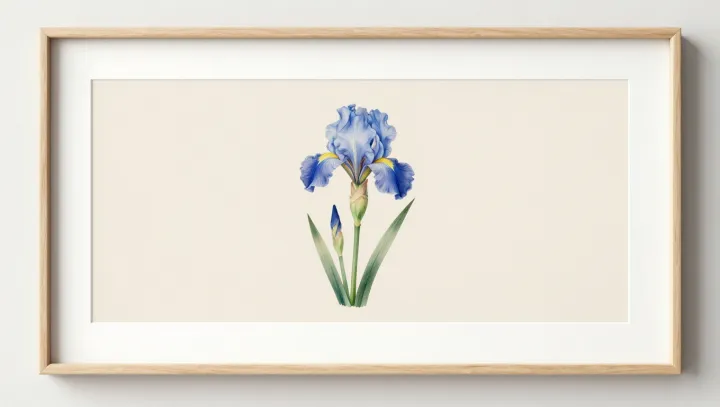
A lone blue iris on white feels honest, yet biology would file it under failure. In real habitats, an isolated iris faces pollination collapse, because gene flow, pollen vectors and plant density operate as network conditions, not as solitary acts of beauty.
The odd part is that the print does not feel broken. Human vision compresses context. It hunts for closure, then declares the frame a finished unit. Gestalt grouping and figure–ground segregation strip away the meadow, the insects, the soil microbiome, leaving a clean icon that our brains treat like a complete sentence, despite its ecological ellipsis.
Design culture doubles down on that bias. Minimalism treats absence as emphasis. One iris stands in for an entire reproductive web, a metonym that erases pollinator mutualism and population dynamics while still satisfying the viewer’s need for order. The ecosystem pays attention to allele exchange and demographic viability; the print answers only to composition and cognitive efficiency, so the single bloom reads as whole while, in nature, it would be on the verge of silence.