
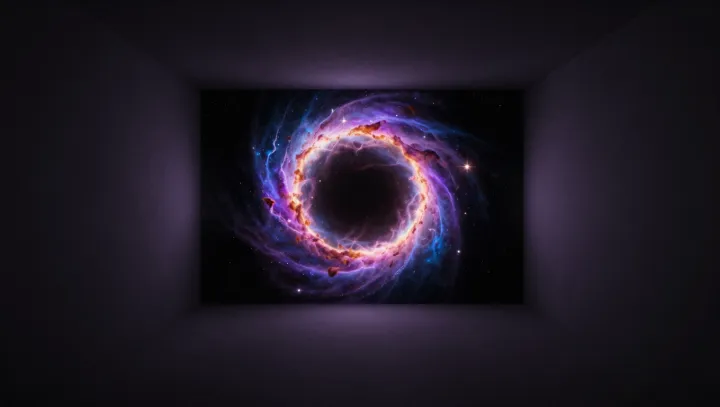
Perfection in space is usually a lie. A nebula that looks like a clean ring is less an act of order than a trick of physics and perspective. When a star sheds its outer layers, it launches an almost isotropic stellar wind, a flow of particles that expands at roughly the same rate in every direction, so the first imprint on the surrounding gas is not a jagged splash but a nearly spherical shock front.
The surprising part is not the circle. The surprise is that chaos does not fully erase it. As the blast drives outward, hydrodynamic instabilities ruffle the shell, and radiative cooling lets some regions condense while others stay hot and thin, yet the global geometry stays close to spherical because the energy and momentum injection are dominated by the central star, not by small local clumps. Small scale turbulence writes filigree on the surface; it does not redraw the outline.
The final illusion comes from simple projection. A three dimensional shell, seen from afar, stacks the brightest emission along the rim, where the line of sight crosses more gas, so a roughly spherical nebula photographs as a thin, engineered ring. Change the viewing angle and the same object would look distorted, proof that the circle is not design but geometry caught at one lucky angle.