
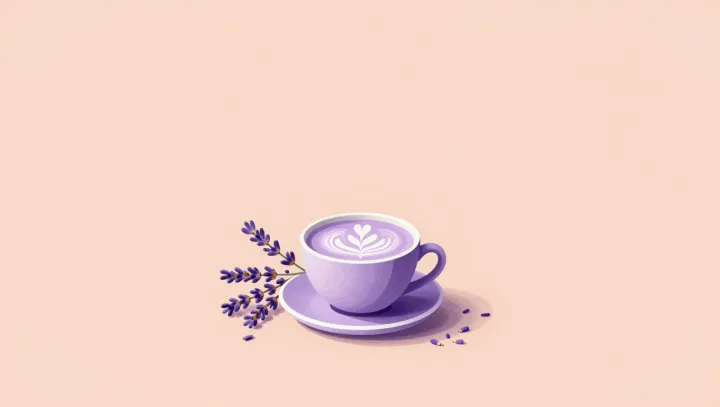
Color hits first. Long before aroma or flavor, that pale violet surface reaches the visual cortex, where edges, contrast and hue are parsed with assembly-line efficiency, then relayed to limbic circuits that care about threat and relief.
The striking claim from sensory scientists is that a lavender-tinted latte can start dialing down arousal while it is still on the counter, because the brain treats color as a shortcut to prediction. Over years of associative learning, purple shades often ride alongside cues of rest: evening light, bath products, eye masks, spa branding. Those pairings tune synaptic plasticity in networks linking the visual cortex, hippocampus and amygdala, so that a glimpse of that hue now forecasts safety, softness, lower demand on attention, and the autonomic nervous system begins to ease sympathetic tone.
Equally subversive is the idea that expectation, not chemistry, launches the first wave of calm. Studies using functional magnetic resonance imaging and skin conductance show that when participants view images of lavender products, activity nudges upward in prefrontal regions that regulate the amygdala, while indices of stress such as heart rate variability subtly shift toward parasympathetic dominance. The latte’s pigment becomes a visual placebo, harnessing top‑down modulation and predictive coding so that by the time steam touches the nose, the brain has already started rewriting the body’s threat forecast in softer colors.