
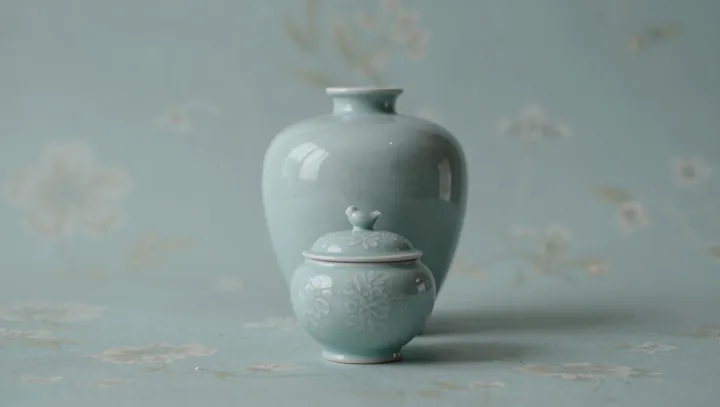
A modest pale blue jar, not the elaborate vase behind it, silently takes command of the still life. This is no accident of taste; it is an exploit of the eye’s early hardware, where edge detection and contrast coding outrun any appreciation for size or decorative detail.
The first mistake is to assume scale wins. It does not. Primary visual cortex, or V1, allocates its resources to sharp luminance boundaries and high spatial frequency edges, not to grand outlines. The jar’s crisp rim and clean silhouette generate stronger activity in orientation-selective neurons than the blurred, patterned contour of the background vase, whose busy motifs smear into low-frequency noise once projected onto the retina.
Texture finishes the theft. Our visual system, through mechanisms such as contrast gain control and surface reflectance analysis, gives priority to reliable cues about material. The jar’s matte, finely graded blue offers stable micro-variations in brightness that local contrast filters can lock onto, creating a coherent object file in visual working memory. The ornate vase, with its glossy glare and intricate ornament, produces saturated highlights and low-contrast shadows that the system partially discards as unreliable. Attention follows signal quality, not ornament. So the small jar, by aligning itself with the brain’s favored statistics, becomes the scene’s quiet magnet.