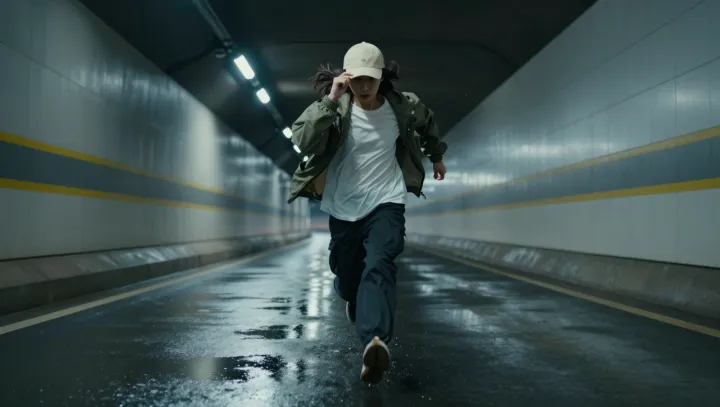
Brown on brown should be boring. Yet a person dressed in almost identical shades can look both camouflaged and strangely highlighted at once. The effect starts in luminance contrast, not hue: the visual cortex ranks light–dark boundaries long before it cares about color categories, so a tiny shift in brightness between jacket, skin and background sets up invisible fault lines the brain cannot ignore.
What really misleads perception is that these fault lines are weak in some zones and sharp in others. Where cloth and background share similar luminance, edge detection circuits in V1 and V2 fire less, so the figure bleeds into the scene. Where a sleeve seam, collar ridge or shadow creates a steeper gradient, those same orientation-selective neurons spike, carving out crisp silhouettes. The outfit seems to flicker between presence and absence as the gaze roams.
Texture finishes the trick. Smooth wool against matte wall or suede against polished leather alters spatial frequency content, feeding different signals into contrast gain control even when color values match. The brain, chasing coherence through figure–ground segregation, ends up doing both jobs at once: suppressing low-contrast zones as background while amplifying micro-contrasts along folds, hems and hair. That is how one brown body can quietly vanish and, in the same glance, snap into focus.