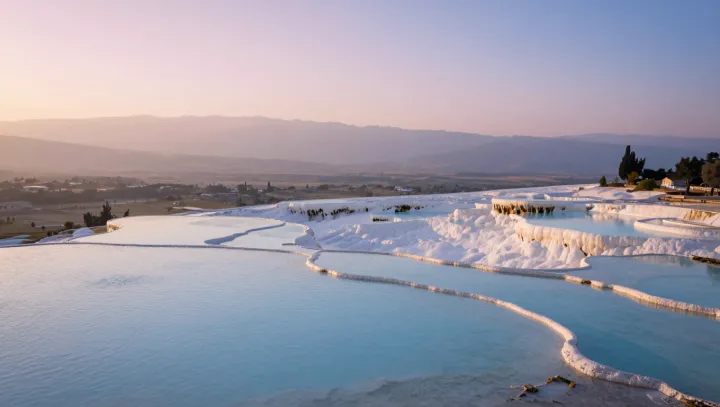
Those porcelain steps on a hillside are not stable at all; they are in constant negotiation with flowing water. Each shallow basin exists because spring water, already loaded with dissolved calcium carbonate, spills, slows, and then abandons part of its mineral cargo at the lip. There, on that thin overflow line, crystals accrete grain by grain, building a rim that traps water just long enough to look serene.
The real trick is that geometry, not intention, keeps the tiers even. Where flow concentrates, hydraulic shear erodes the rim and shaves it down; where flow thins, supersaturation wins and more travertine precipitates. This feedback loop, driven purely by gravity and carbonate equilibrium, pushes each lip toward a narrow band of heights. Too high, and less water crosses, so chemistry thickens the edge. Too low, and faster currents scour the growing stone.
Seen that way, the terrace field is a self-tuning device. Capillary effects, micro-eddies, and degassing of carbon dioxide all bias deposition right at the overflow line, locking depth and step spacing into place while the system keeps moving. The pools look carved and finished. They are neither. They are a standing snapshot of minerals, water, and slope solving for balance in real time.