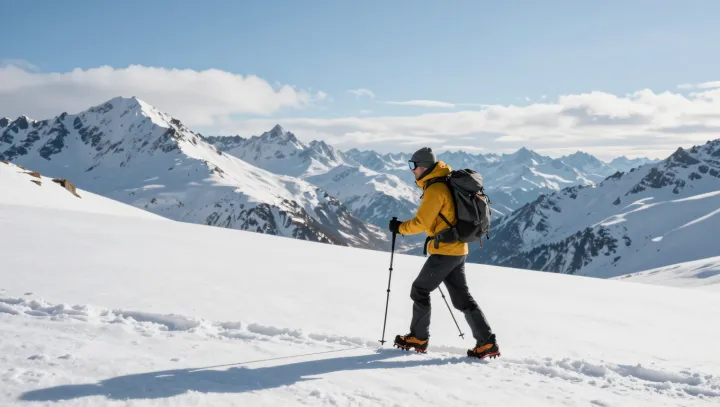
A fragile snowpack, not the mountaineer, really decides when a mountainside will move. On a narrow ridge, snow rests in layered sheets. Some are dense. Some are granular. Hidden among them, a weak layer behaves like a fault in rock, ready but not yet activated.
The unsettling truth is that a step of only a few centimeters can be enough. That small displacement adds a local load that changes shear stress within the slab, pushing a buried weak layer past its shear strength. The collapse of that layer, often a band of depth hoar or faceted crystals, creates a sudden loss of support. A crack forms. Then it races outward far faster than a person can move.
What looks like a tiny footprint can therefore serve as a trigger, not a driver. Once the weak layer fails, fracture propagation turns the snowpack into a single connected slab, governed by fracture mechanics rather than human scale intent. The failure line can jump across ridges and rollovers, recruiting more connected slabs until thousands of tons of snow detach and accelerate downslope under gravity. The mountaineer supplies the last straw. The mountain supplies everything else.