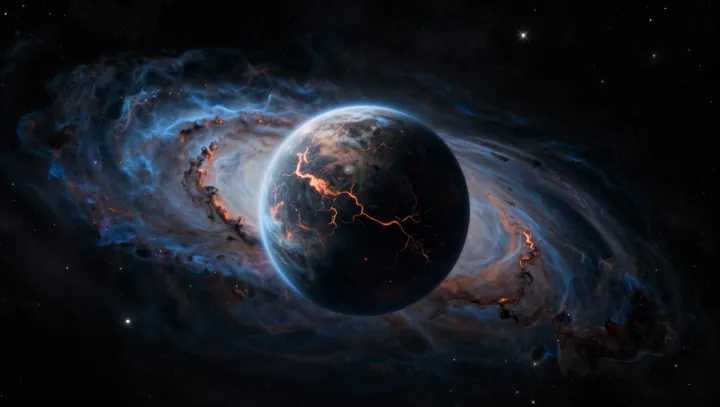
Emptiness offers more security than it sounds. Once a planet is flung free as a so‑called rogue, orbital mechanics stack the odds in favor of endless solitude rather than a quick recapture by another star.
At the moment of eviction, gravity is not gentle. Close encounters with a gas giant or a passing star act as a gravitational slingshot, giving the smaller world a speed above the escape velocity of its home system. That surplus energy turns the planet into a bound object of the galaxy instead, moving on a galactic orbit set by the combined gravitational potential of billions of stars and dark matter. To reverse that freedom, another star would have to steal just the right amount of kinetic energy in a three‑body interaction, a process celestial‑mechanics models show is possible but statistically rare.
The real surprise is how much empty space wins. Stars themselves are tiny compared with the vast volume between them, and their gravitational wells shrink fast with distance, following the inverse‑square law. A rogue planet can pass light‑years away and feel only a weak tidal nudge, not a capture. N‑body simulations indicate that even in dense star clusters, full capture cross‑sections are minuscule. So the planet drifts on, not because stars fail to pull, but because almost never do they pull in exactly the right way.