
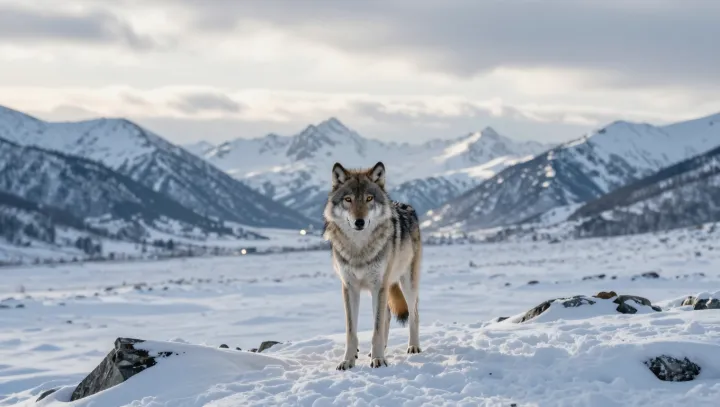
Cold is not the wolf’s enemy; it is its operating system. Across open snow, a wolf can lope for long distances in subzero wind while spending less energy per kilogram than many pets on a short, leashed stroll through slush.
The trick starts in the legs. A countercurrent heat exchange network in the paws lets arterial blood dump warmth into returning venous blood, so the feet run just above freezing while the core stays stable, cutting the need for constant thermogenesis. Short, compact hairs on the muzzle and limbs freeze, forming an insulating crust that reduces convective heat loss as snow blasts past.
Energy budgeting is even sharper inside the muscles. Wolves rely heavily on oxidative muscle fibers packed with mitochondria, tuned for aerobic endurance rather than explosive bursts. Instead of burning through circulating glucose the way many companion animals do on a brisk walk, they preferentially oxidize fatty acids stored along the torso and around organs, a fuel that yields more ATP per gram and keeps blood sugar from spiking and crashing.
Gait mechanics close the loop. The familiar ground-covering lope holds a near-constant stride frequency, limiting the start–stop accelerations that waste energy in many pets tugging at a leash. Deep chests and compliant spines act as biological springs, storing elastic energy with each impact and releasing it into the next stride, so blizzard sprints run on physics as much as on muscle.