
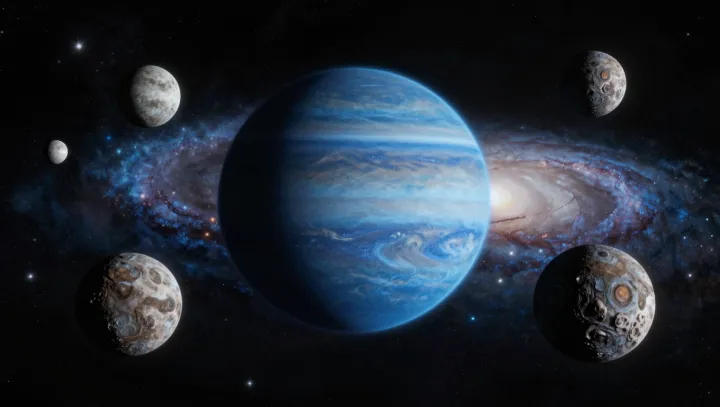
An empty planet sounds powerless. It is not. A planet is mostly vacuum between nuclei and electrons, yet that sparse matter generates a gravitational field strong enough to choreograph every moon around it. No contact. No cables. Only the sum of mass and the geometry written into spacetime decide the script.
The unsettling part is this: nothing pushes the moons. Gravity is not a shove but the curvature described by general relativity, where mass tells spacetime how to curve, and curved spacetime tells moons which geodesics to follow. Their orbits are free‑fall trajectories, continuous solutions of Newtonian two‑body dynamics refined by Einstein, not the result of any steering impulse or hidden tether.
Control here comes from constraint, not command. Once a moon’s velocity and distance set its gravitational potential energy and angular momentum, the allowed path shrinks to a narrow family of ellipses. Tiny tidal forces, described by differential acceleration across the moon’s body, bleed energy and lock rotations, turning chaotic beginnings into regular periods. The planet never touches its moons, yet by shaping spacetime and the available phase space, it dictates where they can be and how they return, orbit after orbit.