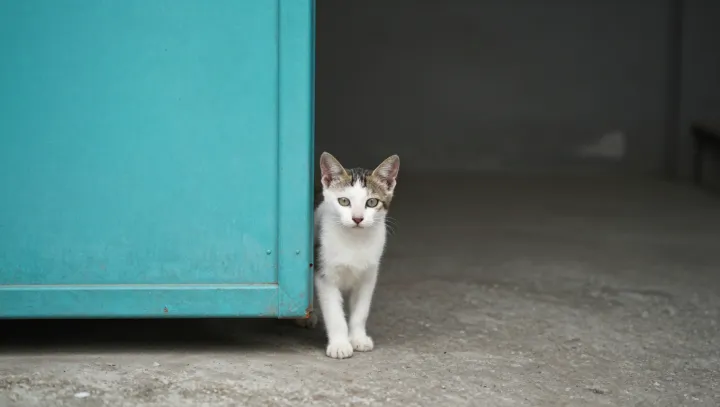
Street chaos is kinder to a kitten than it looks. Low detail in each eye is not a death sentence when the brain is wired to prize motion and edges over fine texture. In early development, retinal ganglion cells and the visual cortex respond strongest to contrast borders and looming shapes, building a fast warning channel instead of a high-definition picture.
The odd truth is that a kitten is more motion analyst than image collector. Large moving objects generate optic flow across the retina, a global pattern that flags the direction and speed of threats long before any whisker or paw arrives. Neurons tuned to temporal frequency light up for flicker and drift, so a rolling tire or swinging bag stands out even if its logo or color pattern is a blur.
Even sharper is the face-level radar. Whiskers, or vibrissae, project to the trigeminal system and barrel cortex, forming a tactile map that updates every tiny head bob. Airflow deflection and brief wall contacts encode distance and gap width with millimeter precision, letting a kitten trace safe corridors between glass shards, wheels and curbs while vision only sketches a crude outline of the alley.
The real bias is toward redundancy, not clarity. Vestibular signals from the inner ear, paw pad mechanoreceptors and low-resolution contrast cues are fused in multisensory circuits, so a stumble in one channel is backed by two others. What looks like fearless threading through danger is really a layered control system that treats sharp vision as a luxury, not the core survival tool.