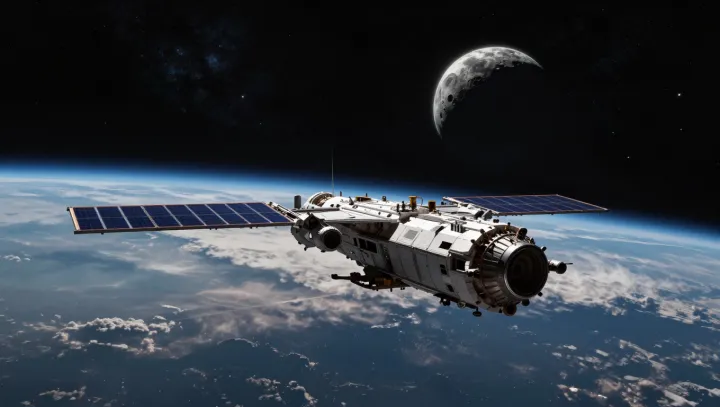
Gravity in orbit is not weak. Near a typical low satellite track, Earth’s pull is only slightly less than on the surface, yet the craft never crashes. That tension between strong attraction and endless survival defines what orbital motion really is.
Weightlessness in orbit is mostly a marketing myth. The satellite is in pure free fall, experiencing a gravitational acceleration only modestly below the familiar surface value, but its enormous sideways velocity keeps shifting the target. As it falls, the ground curves away at almost exactly the same rate, so the trajectory closes on itself and becomes a bound orbit. This is just Newtonian mechanics in action, with gravity providing the centripetal acceleration needed to constantly bend the velocity vector toward Earth.
Orbit, then, is less a place and more a state of continuous failure to hit the ground. Inside the cabin, astronauts float not because gravity vanished, but because everything around them shares the same free‑fall path, erasing contact forces that we usually label as weight.