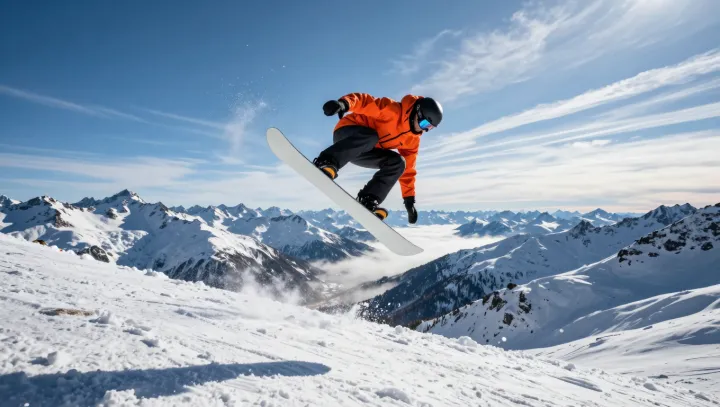
Gravity is not the villain of snowboarding; it is the power grid. A board once copied from surf culture now works as a rotating lever, feeding on vertical drop. As riders enter a jump or halfpipe, gravitational acceleration converts height into speed, then into angular momentum at takeoff.
The surprise is how little raw muscle matters. What really runs the show is edge control and center of mass management, concepts straight from classical mechanics. By carving a precise arc toward the lip, riders pre-load torque into their bodies, then snap off the snow so that the same force that would cause a fall instead drives spins and flips.
The biggest tricks look chaotic but are tightly engineered. Kick ramp curvature, takeoff angle, and friction coefficients are tuned so the vertical component of motion becomes just enough rotational energy for a double or triple cork. Air resistance, once a nuisance, becomes a brake riders use by opening their arms or flattening the board to fine-tune rotation mid-flight.
The bold claim is that modern snowboard parks are outdoor physics labs disguised as playgrounds. Course designers effectively write equations in snow, setting the drop, radius, and lip height so gravity performs repeatable work on every run. Riders then edit those equations with micro-adjustments of posture, turning a former enemy into a tool as precise as any metronome.