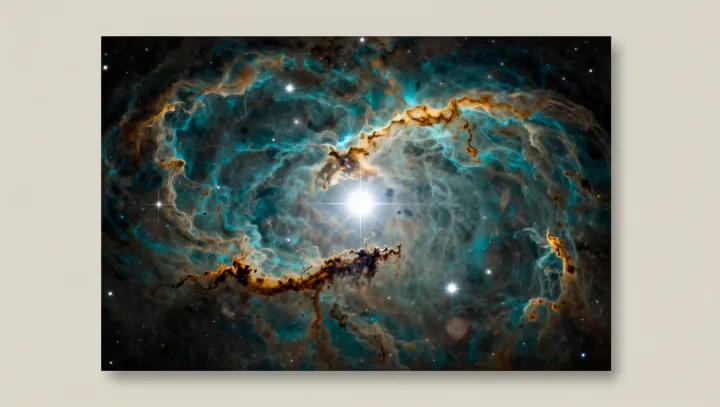
Tiny is a lie. That faint smudge in the eyepiece may extend across dozens of light-years, yet distance crushes its apparent size into a few arcminutes, a fraction of the full Moon on the sky.
The key mismatch is geometry. Light from a nebula spreads out as an expanding sphere; its flux obeys the inverse-square law, so every extra unit of distance slashes brightness per unit area on your retina, even while the physical cloud may be large enough to engulf thousands of solar systems. Angular diameter, the angle the object covers in the sky, shrinks as its distance grows, so a structure wider than a star cluster can project a footprint no larger than a thumbprint at arm’s length.
Human biology finishes the trick. Photoreceptors in the retina operate with limited spatial resolution and sensitivity, especially in low light, so the eye integrates the meager photons into a soft blur instead of a crisp shape. Nebular gas has low surface brightness; its emission lines in hydrogen and oxygen radiate gently rather than in concentrated beams, leaving only a dim patch for unaided vision. Telescopes and long-exposure CCD imaging recover the true sprawl, but to the naked eye that vast cloud stays pinned to a single, misleadingly small stain on the dark.