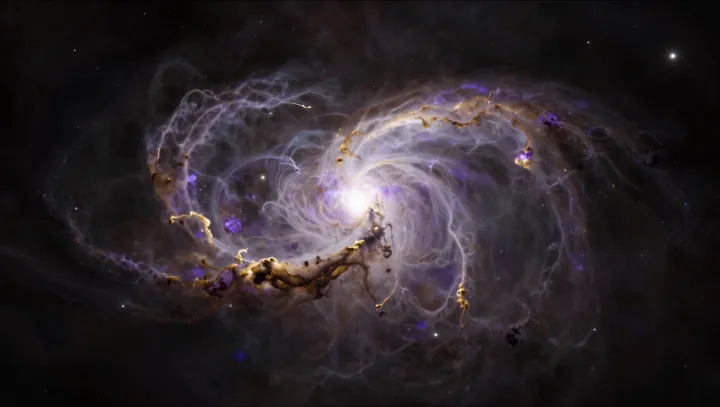
Shredded spiral arms look like pure destruction, yet they mark one of the most productive star factories in the universe. When two massive galaxies interlock, gravity stops behaving like a gentle architect and acts more like a hydraulic press on interstellar gas, forcing order out of apparent chaos.
The harsh claim from observers is simple: the more violent the encounter, the more intense the starburst. As disks interpenetrate, tidal forces drag out long, glowing streams called tidal tails, while shocks race through molecular clouds. Gas that once drifted in hydrostatic balance is rammed together, its density spiking past the threshold where gravitational collapse, or Jeans instability, becomes unavoidable. In those compressed knots, protostars ignite faster than in any quiet galactic suburb.
Counterintuitive, though, is how this wreckage improves efficiency. Collisions stir turbulence, but they also drive gas toward the merged core, deepening the gravitational potential well and raising pressure in the interstellar medium. Star clusters assemble in compact clumps, some so dense they may evolve into globular clusters. The same impact that tears stellar disks into fragments seeds thousands of new suns along the scars, turning a scene of apparent ruin into a decisive phase in galactic growth.