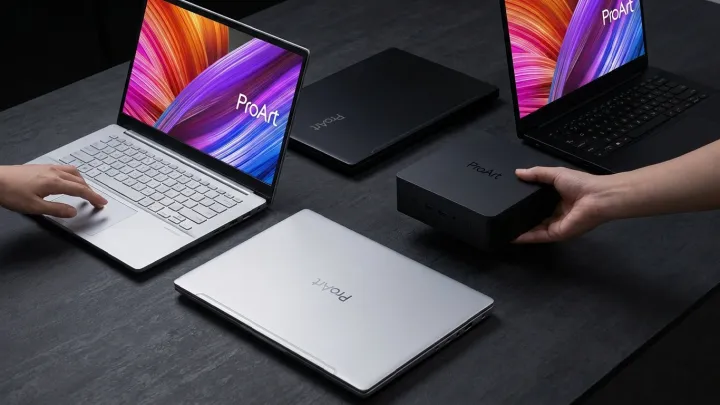
One petaflop in a laptop sounds excessive, yet that figure now sits at the center of ASUS’s new ProArt line built around NVIDIA RTX Spark. On show are the ProArt P16 and P14 notebooks and a compact ProArt Mini PC, all framed not as gaming rigs but as personal inference engines for editors, 3D artists and coders who cannot wait on remote clusters.
The boldest move is the insistence on unified memory up to 128GB, a nod to workloads where large language models and high‑resolution timelines compete for the same address space, and where PCIe bottlenecks quietly erode productivity. ASUS couples that with Lumina Pro OLED panels tuned for accurate color, arguing that frame‑perfect grading matters as much as tensor throughput when AI‑assisted tools sit directly inside the creative pipeline.
More provocative is the bet on local AI agents scheduled to arrive through software updates, turning these systems into always‑on companions that run models on‑device rather than in distant data centers. ASUS points to all‑day battery endurance as the missing link, claiming creators can keep generative tools, asset indexing and voice‑driven control running on trains, planes or client sites without surrendering their data to shared infrastructure.