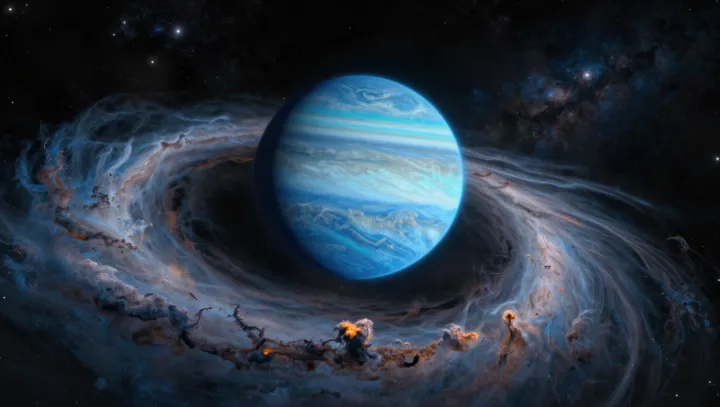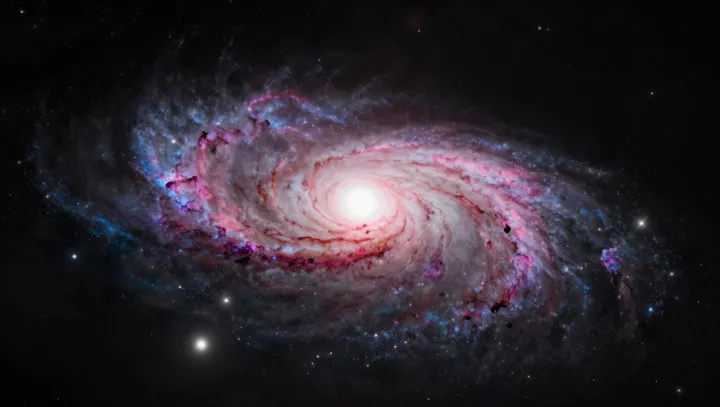
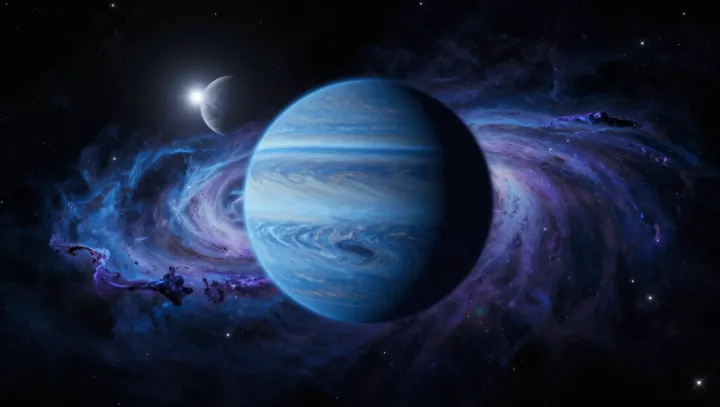
That tiny dot is lying to your eyes. From a gas giant’s cloud tops, a massive O‑type star shrinks to a pinprick, yet its photon flood does not politely stop at your horizon; it keeps racing outward, thinning but still dangerous.
The key shock is this: brightness to a human eye is a terrible proxy for power in space. Luminous intensity follows the inverse‑square law, so every doubling of distance quarters the flux, but an O‑type star starts from such an absurd luminosity that even a shredded fraction remains lethal. Its output in extreme ultraviolet and soft X‑rays ionizes hydrogen across interstellar gas, stripping electrons and leaving behind vast H II regions. To you on the gas giant, the point looks tame. To a hydrogen atom in a nearby cloud, it is an executioner.
Equally counterintuitive is how little material the star needs to light up. Interstellar medium is almost vacuum, yet that is exactly why radiative transfer works so far; photons rarely collide, so they travel immense distances before being absorbed. Each absorbed high‑energy photon triggers recombination and line emission, giving the nebula its glow. Seen locally, the star is a dot. Seen across light‑years, it is an engine of ionization fronts, shock waves, and sculpted cavities, carving structure into gas that never cared what the sky looked like from a single gas‑giant world.