
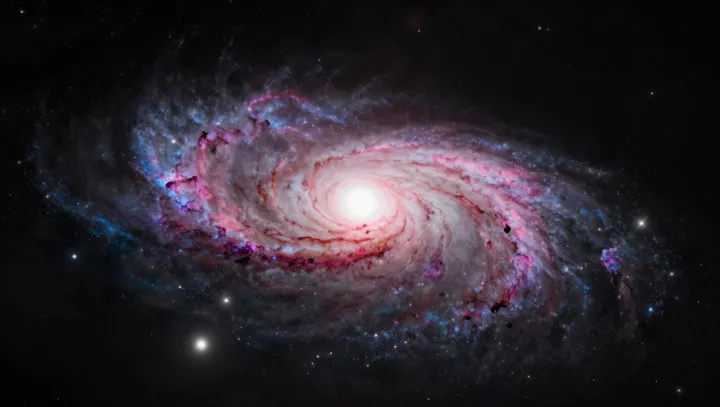
Violence, not order, is often the best guide to structure in a galaxy. A warped disk, shredded by past encounters, still has its stars and gas locked into orbits set by gravity, and that gravitational potential is dominated not by the visible spiral arms but by an extended halo of dark matter that never shines.
So the chaos is misleading. Bright knots of star formation and twisted dust lanes look random, yet radio observations of neutral hydrogen and optical spectroscopy of ionized gas draw out an almost eerily smooth rotation curve, a plot of orbital speed versus radius that refuses to follow the drop expected from luminous matter alone. That flat profile is the signature of a massive, spherical dark matter halo whose density profile fixes how fast material circles at each distance from the center.
The real surprise sits in the arms themselves. Their grand design, even when kinked and bent, behaves like a density wave set by resonances within the disk and the surrounding halo, concepts formalized in galactic dynamics and N-body simulations. Local collisions may contort the visible pattern, but the underlying orbits keep time with the halo, turning a wrecked façade into a clean experiment on invisible mass.