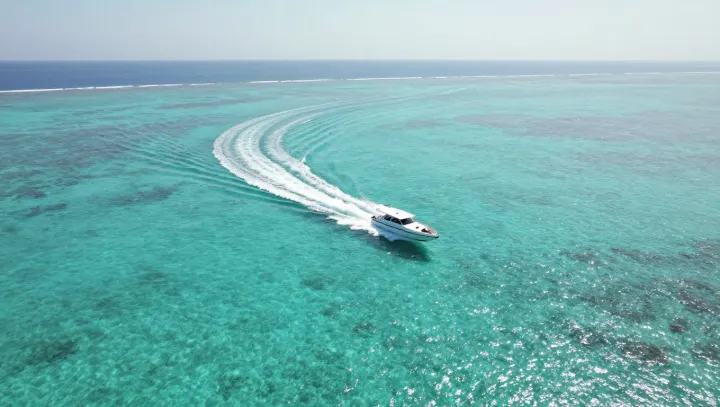
An S-shaped wake behind a speedboat looks decorative. It is not. Each curve marks how momentum resists any attempt to turn, forcing water into sweeping arcs as the hull yaws and the rudder bites. Conservation of momentum and centripetal acceleration, not aesthetics, sketch that sinuous track across the surface.
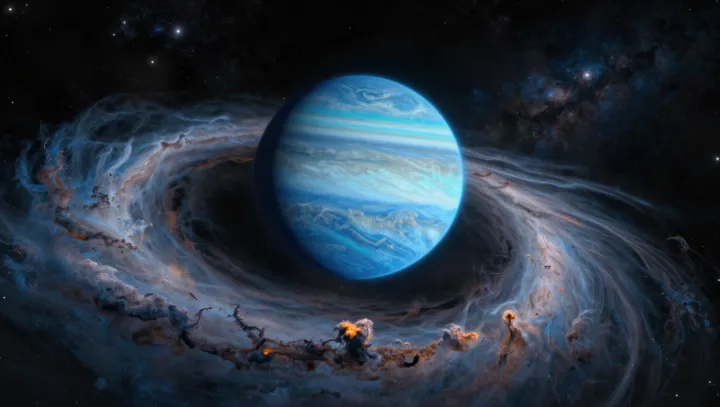
The same stubbornness of motion powers a spacecraft’s gravity assist. A probe hurtling past a planet falls through a curved spacetime well, trading direction for speed as seen in the star’s frame, while its own velocity relative to the local planet stays consistent with orbital mechanics. The planet’s gravity supplies the centripetal force; the conserved quantity is not raw speed alone but energy and angular momentum in a multi-body system.
So the wake is a small, wet rehearsal for a cosmic maneuver. Where the boat’s hull deflects water sideways, the planet’s gravity field bends a spacecraft’s path, both governed by differential equations that tie curvature to force. Watch that S-curve on a lake, and you are watching the same grammar that writes trajectories past distant worlds.