
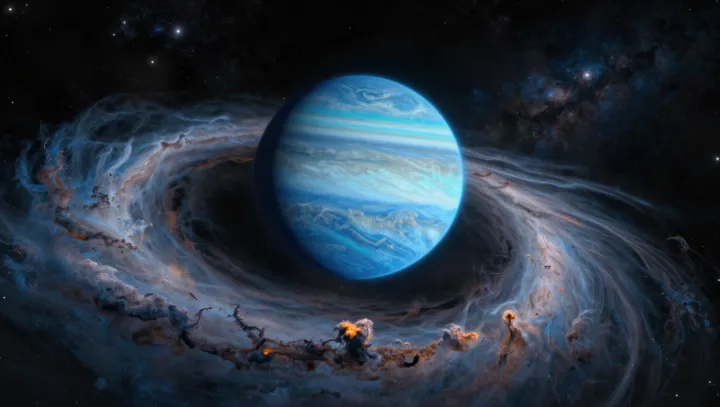
That blue is a lie of omission. A hydrogen–helium giant should look almost colorless, yet its disk turns sharp blue because the upper atmosphere edits sunlight, stripping out red wavelengths and letting short, blue photons leak back to our telescopes.
The key agent is methane, not the bulk hydrogen. Methane molecules, sitting in the rarefied upper troposphere, absorb red and infrared light with very specific spectral lines, while Rayleigh scattering by hydrogen and helium pushes blue light sideways through the gas until some of it escapes. So a planet that is chemically dominated by invisible gases ends up optically branded by a trace constituent that occupies only a slim fraction of its mass yet controls the visible spectrum.
That vivid hue is also a quiet thermometer. To keep methane stable high in the atmosphere, temperatures must sit far below the freezing point of water, cold enough for methane ice and photochemical haze to seed the upper clouds. Those hazes, produced by ultraviolet photolysis and subsequent polymerization, fine-tune the exact shade: thicker aerosols mute the blue toward teal, thinner layers let the saturated blue deepen. Color, in this case, is not decoration but a remote probe of chemistry, vertical mixing and radiative transfer in clouds no probe has yet touched.