
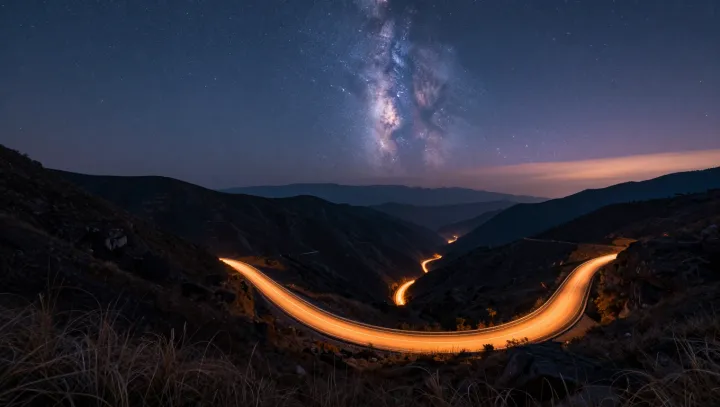
A night sky that appears motionless in a long‑exposure frame is not some cosmic trick; it is a blunt reminder of scale. The Milky Way sits at such vast angular distance that, over a span of seconds, its apparent drift is smaller than the blur created by the camera’s own sensor noise and minor tripod flex, so its structure prints as steady, granular detail while everything nearby betrays movement.
More counterintuitive is the highway below, liquefied into a single band of color. Long exposure exploits a simple rule of image integration: the sensor accumulates photons over time, recording any point that stays put as a sharp object, while anything that changes position during the exposure is averaged into a streak. Car headlights and taillights sweep through many pixels, so the exposure functionally sums their luminous flux into one continuous trail, erasing the vehicles themselves as discrete forms.
Photographers lean on this asymmetry between celestial mechanics and local motion. By choosing an exposure duration short enough to respect the so‑called rule of 500, star points remain tight, avoiding star‑trail arcs caused by Earth’s rotation, yet long enough that dozens of cars traverse the frame. The result feels surreal: a sky that seems frozen not because it truly is, but because the camera has quietly turned time into geometry only where the traffic moves fast enough to reveal it.