
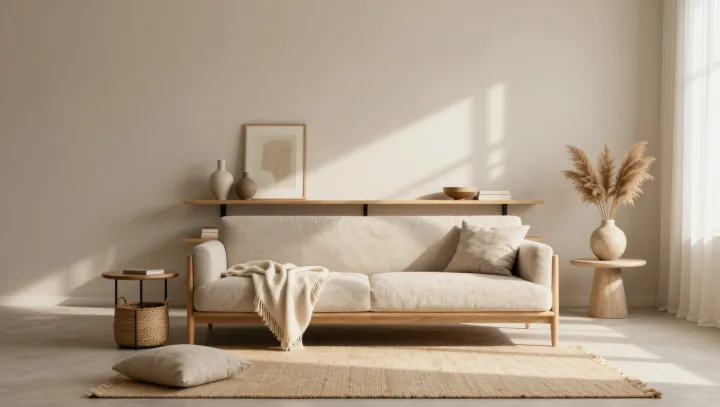
Light on a pale wall makes a stronger argument for luxury than any loud sofa. A neutral living room, stripped of decor, turns into a laboratory for perception, where luminance contrast and surface reflectance quietly run the show. With fewer objects, every shift in daylight, every gradient of shadow, reads as data. The brain, wired for edge detection and depth cues, suddenly has room to process micro-variations in fabric weave, plaster grain, and the matte‑to‑sheen transitions across a floor.
The surprise is simple. Less color often means more information. Saturated hues and busy patterns act like visual noise; they flatten subtle differences in value and obscure the way photons bounce between surfaces, a process described in optics as diffuse reflection. In a restrained space, that bounce becomes legible. A linen curtain shows its warp and weft. A wool rug reveals directional pile. Even a plain oak table offers specular highlights that map its grain, giving the eye continuous micro‑discoveries that feel expensive because they suggest material integrity rather than surface distraction.
What reads as richness is not the count of objects but the density of readable signals. When color and clutter retreat, the hierarchy of light, shadow, and texture takes over, and the room stops shouting in decoration and starts whispering in detail.