
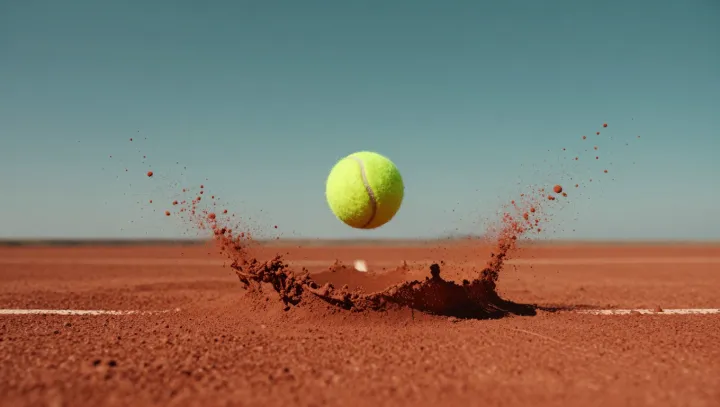
A tennis ball hitting clay is a blunt, public fact-check on physics theory. One blur of yellow, one puff of dust, and the abstract idea of energy conservation is forced into a visible audit: kinetic energy rushes in, and only part of it comes back out as rebound height and speed.
The bounce shows loss first. The ball arrives with translational kinetic energy and angular momentum, then flattens in a sharp spike of elastic deformation while the clay grains shear and compact. That brief squashing, captured in high-speed video and force-time curves, exposes how the coefficient of restitution is not a static number but a response to impact speed, surface compliance, and internal damping inside the pressurized rubber core.
More telling is the skid. Friction is not a textbook arrow but a streak of sliding felt through the racket arm. As the ball strikes with topspin, tangential velocity meets the clay’s rough microstructure, and Coulomb friction converts spin and horizontal speed into heat, particle motion, and a sudden jump in angular velocity. The difference between a clean skid mark and a sharply kicking bounce encodes the friction coefficient more honestly than a lab block on an incline.
What looks like a casual rally is in fact a compact experiment in energy transfer, dissipation, and contact mechanics, repeated with every serve and return, each bounce a tiny peer review written in dust.