
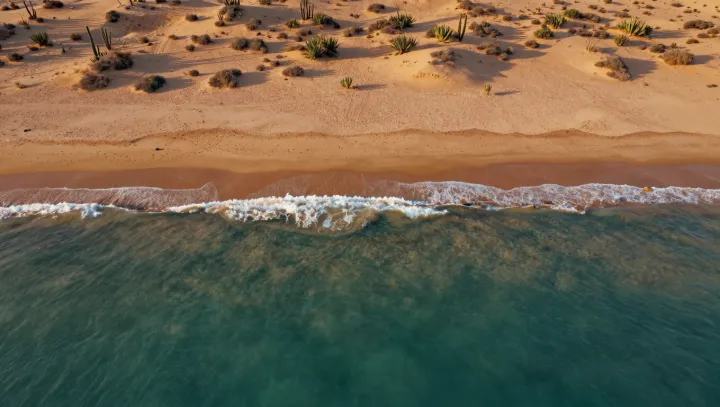
A razor edge can be the most stable shape on a coast. That sounds wrong. Yet wave attack and rock strength often settle into a quiet stalemate, in which the cliff face retreats only millimeters over many human lifetimes while still presenting a clean, sharp front to the sea. Each wave pulse focuses stress on the same narrow line, exploiting joints and bedding planes, so blocks break off cleanly instead of rounding the profile.
By contrast, the nearby desert can look frozen because almost nothing there has the power to reset the surface. Sparse rain means chemical weathering proceeds through slow hydrolysis and oxidation inside rock pores, but with little running water to carry grains away, the products simply accumulate as a thin regolith. Wind abrasion, although dramatic in stories, usually delivers low shear stress spread over wide areas, so it polishes rather than carves deep notches. The sea, in effect, runs a high-energy, high-frequency experiment on the same line of rock, while the desert runs a low-energy, intermittent one over a broad field. Sharpness survives on the coast not because erosion is weak, but because it is focused, periodic, and governed by the mechanical properties of the rock itself.
So the cliff edge keeps its blade while the dune shoulder barely shifts, an odd partnership between relentless impact and almost static decay.