
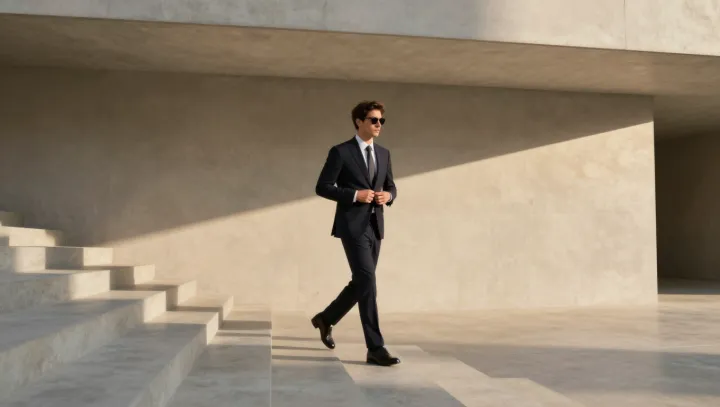
Light on concrete does more persuasion than any speech. A sunlit staircase throws clean verticals and diagonals around a suited body, and those lines quietly feed the brain’s hunger for order. Within a split second, the visual cortex extracts edges, contrast, and bilateral balance, then hands a compressed summary to higher areas that handle social judgment.
Snap competence ratings are not thoughtful; they are shortcuts. Research on thin-slice judgments and face perception shows that people infer intelligence and authority from symmetry, high contrast, and posture before conscious reasoning catches up. A sharp dark suit against pale stone boosts figure–ground separation, exaggerates shoulder width, and straightens the torso, which the motor cortex and mirror neuron systems read as control and preparedness.
Status cues are, bluntly, hacked here. The elevation of the staircase places the man literally higher in the frame, while converging steps act like arrows, directing gaze and inflating perceived centrality. Social cognition circuits, tuned by years of hierarchy learning, bind these sensory inputs with stored stereotypes about formal clothing and leadership. Speech can refine that verdict later, but the fast visual circuitry has already filed him under competent.