
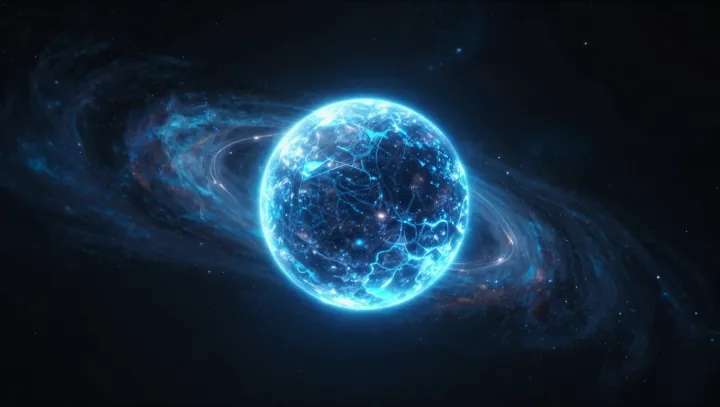
Brightness can be a lie. A sphere of superheated plasma in deep space can blaze with star like intensity while staying fundamentally underpowered at its core, because luminosity cares about energy flow, not social status in the stellar hierarchy. In such an object, thermonuclear fusion is not the main engine; instead, energy can be pumped in from outside. Strong magnetic fields can confine and squeeze charged particles, converting magnetic energy into heat and light through magnetohydrodynamic processes and magnetic reconnection.
The key failure, hidden behind the glare, is gravity. Without enough mass, the plasma never reaches the central pressure and density required for sustained proton proton fusion, even though the outer layers can reach extreme temperatures. Energy can still pour out through bremsstrahlung radiation as electrons are deflected by ions, and through line emission as atoms repeatedly ionize and recombine. Accretion of surrounding gas, or interaction with a nearby compact object, can keep feeding this radiative output while the core remains subcritical.
So the object shines, but it does not live like a star. Its light curve can be volatile, set by magnetic instabilities and changing inflow, rather than by the regulated hydrostatic equilibrium that defines a true main sequence star. What looks from afar like a stable sun can, on closer inspection, be only a temporary flare in a deep, indifferent dark.