
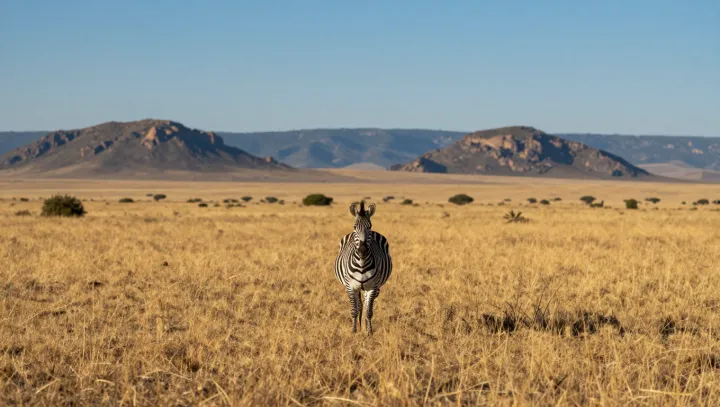
Against bare rock and blond grass, a zebra looks almost obvious, yet its survival strategy is anything but simple. Those black and white bands do not erase the animal; they scramble the outline of a moving body, especially when several stand together, disrupting predator depth perception and motion tracking under strong light on open ground.
More striking than the pattern is the way the whole body is tuned to exposure. Large eyes set high on the head give a wide visual field; sensitive pinnae pivot fast, feeding the auditory cortex with constant updates; elongated limbs and efficient tendon elasticity support rapid flight over rough, dry substrate. Instead of hiding, the animal invests in early detection and sprint capacity, turning openness from liability into warning system.
Energy economics may be the quiet core of this design. A hindgut fermentation system, centered in the cecum and colon, processes coarse grasses that many grazers cannot use, while sweat glands across the striped skin help regulate body temperature during long, hot hours in direct sun. Social structure adds a final layer: tight groups, many eyes, and coordinated escape behavior create a moving confusion field for predators across the plains.