
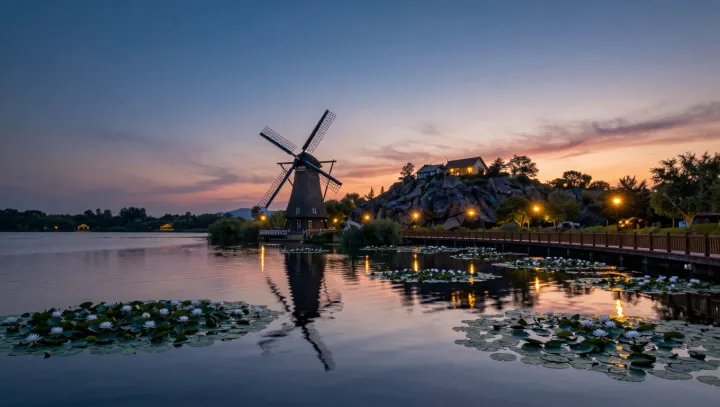
This evening view is not honest. Glassy water, soft hillside glows, the slow turn of a windmill; the whole set is calibrated hardware. Pumps below the surface pull water through baffles sized from computational fluid dynamics models, stretching retention time to trap pollutants while keeping the mirror-flat surface that cameras love.
More stage than wilderness is that hillside. Each point of light sits on a lux chart, mapped against melatonin suppression curves and circadian rhythm research, so the path feels safe but never harsh, and the human hypothalamic–pituitary–adrenal axis gets a subtle signal to stand down. The slope itself is graded for stormwater attenuation, feeding a buried bioswale matrix that handles peak runoff without ever looking like a drain field.
Most deceptive of all is the windmill. It turns just slowly enough to read as quaint, yet its blades are tuned to microclimate targets, trimming gusts along the shore while powering the aeration system that keeps eutrophication at bay through controlled dissolved oxygen levels. What passes for untouched dusk is, in truth, a full-scale stress-management device, its machinery politely disguised as serenity.