
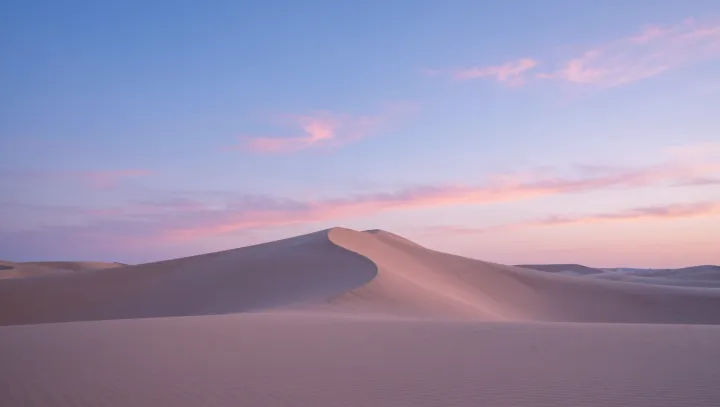
A still dune lies. Yet it behaves like a seismograph for air. Each pink ripple across its flank is not decoration but data, written by shear stress where moving air grips loose grains and sorts them by size and density into orderly ridges and troughs.
This quiet surface is opinionated. It records wind direction through the asymmetry of each ripple, with the gentle stoss slope facing the flow and the steeper lee slope hiding in its lee, while grainfall and small avalanches there archive the strongest recent gusts in cross‑bedded layers. Minute changes in wind velocity alter saltation paths and impact angles, tweaking crest spacing the way a slight change in frequency shifts a signal on an oscilloscope.
Light writes here as well. As the sun climbs, differential heating between crest and hollow drives tiny convection cells, changing humidity and boundary‑layer turbulence just enough to free finer grains, so albedo, thermal inertia and even subtle color shifts trace exposure time and moisture. What looks like a single blush of dawn is in fact a stratified record, each ripple a short entry in a long logbook of air and fire.